
What is medical billing automation and why does your practice need it?
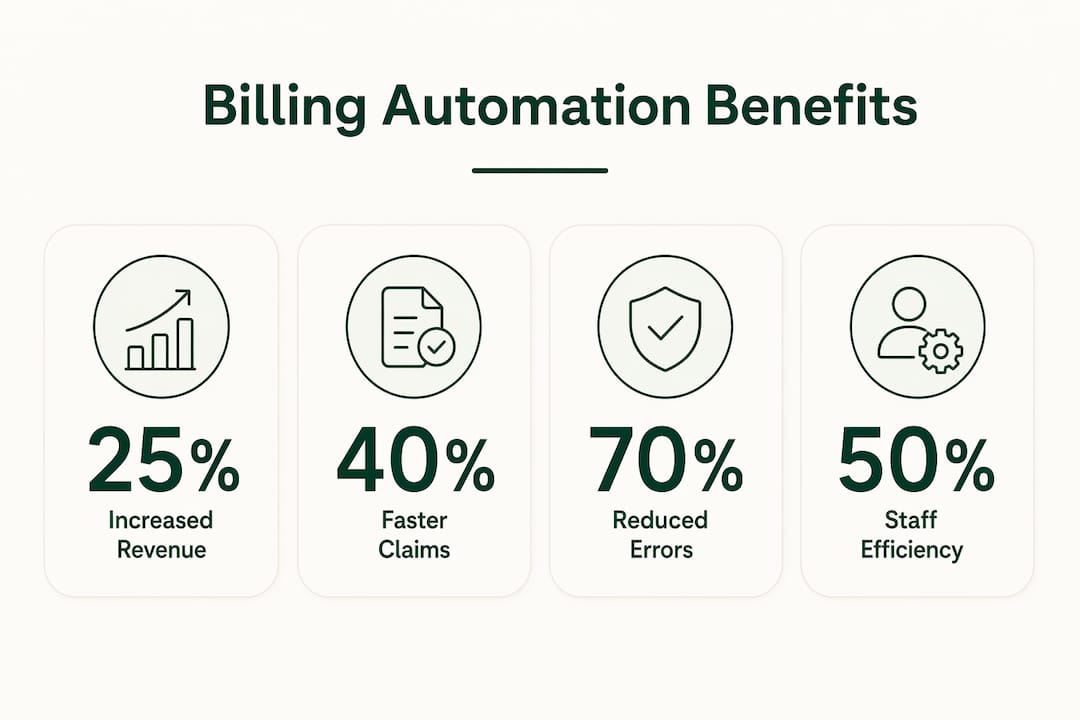
Medical billing automation is the use of AI-driven software to handle claims processing, eligibility verification, coding, and payment reconciliation without manual intervention at every step. The core promise is straightforward: fewer errors, faster reimbursements, and a billing team that spends its time on exceptions rather than data entry.

Practices that still rely on manual workflows face a compounding problem. Claim denials cost the US healthcare system billions annually, and most of those denials trace back to preventable errors in coding or eligibility verification. Platforms like athenahealth, CureMD, and Waystar have built their entire product lines around eliminating that failure point.
The core functions automated billing software handles include:
- Eligibility and benefits verification before the appointment
- AI-assisted medical coding using ICD-10 and CPT code sets
- Automated claims submission and real-time scrubbing
- Denial detection and appeal workflow routing
- Payment posting and reconciliation
- HIPAA-compliant audit trails and reporting
Revenue cycle automation does not replace your billing team. It removes the repetitive work that buries them, so they can focus on the cases that actually require judgment.
Key benefits of automating your billing process
Faster reimbursements are the headline benefit, but the operational gains run deeper. Automated billing software reduces the time between patient encounter and claim submission from days to hours, which directly improves cash flow.
- Error reduction: AI coding tools cross-reference clinical documentation against payer rules before submission, catching mismatches that manual reviewers miss under volume pressure.
- Staff workload relief: Eligibility verification and claim submission are the two most time-consuming manual tasks; automating both frees staff for patient-facing work.
- Denial prevention: Predictive analytics flag high-risk claims before they go out, not after they bounce back.
- Compliance adherence: Real-time audit tools monitor payer policy changes and regulatory updates continuously.
- Reporting visibility: Automated dashboards surface denial rates, days in accounts receivable, and collection ratios without manual spreadsheet pulls.
Healthcare providers report measurable financial gains shortly after deploying comprehensive RCM automation platforms, with improvements showing up in both net collection rates and days in accounts receivable. The shift also repositions staff roles. Rather than re-keying data, your team handles patient advocacy, payer escalations, and compliance oversight — work that actually requires a human.
How to select the right automated billing software for your practice

The wrong platform costs you twice: once in licensing fees, and again in the productivity lost to a poor fit. Start with your specialty. A dermatology practice and an ambulatory surgery center have fundamentally different coding complexity, and the software needs to match.
Key selection criteria:
- Specialty support: Does the platform offer condition-specific templates for your specialty? CureMD supports 30+ specialties with dedicated workflows.
- EHR integration: Billing automation only works if it connects cleanly to your existing electronic health records system. Verify the integration depth, not just the checkbox.
- KLAS recognition: Independent rankings from KLAS Research give you a vendor-neutral read on real-world performance. Athenahealth holds Best in KLAS for Overall Independent Physician Practice Suite for multiple consecutive years; CureMD is a Top Performing RCM Vendor by KLAS.
- AI feature set: Look for natural language processing for coding, predictive denial analytics, and automated prior authorization.
- HIPAA compliance and security: Confirm Business Associate Agreement terms, data encryption standards, and access controls before signing.
- Scalability: Can the platform handle your patient volume in two years, not just today?
- Customer support model: 24/7 support matters when a claim batch fails at 9 PM before a month-end close.
Providers like ModMed, NextGen Healthcare, and AMBSI each serve distinct market segments, from specialty-focused AI assistants to ambulatory surgery centers and independent practices. Matching the platform to your practice type is more important than chasing the most feature-rich option on the market.
Best practices for transitioning from manual to automated billing
A rushed migration creates more denials, not fewer. The practices that transition successfully treat it as a phased project, not a software swap.
- Audit your current state first: Map your existing denial reasons, average days in AR, and staff time per claim before you touch the new system.
- Validate clinical documentation upfront: Faulty encounter notes cause denials even when the billing automation is working correctly. Fix documentation quality at the source.
- Run parallel workflows during go-live: Keep manual processes running alongside the new system for the first billing cycle to catch gaps before they affect cash flow.
- Migrate in phases by claim type: Start with your highest-volume, lowest-complexity claims. Build confidence before automating complex or high-value cases.
- Assign exception owners: Every automated workflow needs a named staff member responsible for reviewing flagged claims. Automation without human oversight creates blind spots.
- Set baseline KPIs before launch: You cannot measure improvement without a starting point. Track denial rate, first-pass resolution rate, and days in AR from day one.
The biggest transition risk is data integrity. Garbage data going into an automated system produces garbage claims coming out, faster than before.
Tips for maximizing your medical billing automation success
Getting the software live is the easy part. Sustaining the gains takes deliberate management.
- Build exception-based workflows: Automate the routine 80–90% of claims and route only the complex cases to senior staff. This is where the real ROI lives.
- Run regular system audits: Payer rules change constantly. Schedule quarterly reviews of your automation rules to catch outdated logic before it generates denials.
- Create feedback loops: When a claim is denied, trace it back to the automation rule that passed it. Fix the rule, not just the claim.
- Monitor coding accuracy rates: AI coding tools improve with feedback. Most platforms let you flag miscoded claims to retrain the model.
- Integrate fraud screening automation: Automated fraud detection tools cross-reference billing patterns against known abuse signatures, reducing both payer audits and internal compliance risk.
Pro Tip: Add fraud screening automation at the pre-submission stage, not as a post-denial review. Catching a problematic billing pattern before the claim goes out protects your practice from payer audits and potential recoupment demands.
Avoid the common mistake of treating automation as a set-and-forget system. The practices that see sustained improvement review their denial dashboards weekly and treat every spike as a signal to investigate the underlying rule.
Case studies of successful billing automation in US healthcare settings
Real-world outcomes vary by practice size and specialty, but the pattern is consistent: automation reduces denials, accelerates cash flow, and frees staff for higher-value work.
| Practice Type | Platform Used | Key Outcome |
|---|---|---|
| Independent physician group | Athenahealth | Reduced staff burnout; specialty-specific workflows cut coding errors |
| Multi-specialty clinic | CureMD | AI medical scribe integration improved documentation quality and RCM throughput |
| Specialty practice (dermatology/ortho) | ModMed | AI assistants automated prior authorization and denial appeals |
| Hospital-affiliated provider network | Waystar | Financial clearance automation improved upfront collections; NPS above 74 |
| Ambulatory and multi-specialty group | NextGen Healthcare | AI clinical documentation and intake automation reduced administrative burden across departments |
Lessons from these implementations:
- Specialty-specific templates matter more than generic platforms for complex coding environments.
- Practices that invested in staff training during go-live saw faster adoption and fewer post-launch denials.
- Integrated billing solutions that connect scheduling, clinical documentation, and claims submission outperform point solutions that only automate one step.
- Denial recovery tools with AI-assisted appeal drafting recover revenue that manual teams deprioritize under workload pressure.
How to integrate billing automation with your existing workflows
Automation fails when it runs in a silo. The full revenue cycle runs from patient scheduling through final payment, and connectivity across every step is what separates a functioning system from a patchwork of disconnected tools.
Practical integration steps:
- Map the full patient financial journey: Identify every handoff point from scheduling to collections and confirm your automation platform touches each one.
- Connect your EHR bidirectionally: Billing automation needs to read clinical data and write back status updates. One-way integrations create reconciliation gaps.
- Break department silos: Front desk, clinical, and billing teams need shared visibility into claim status. Cross-department dashboards prevent the "not my problem" handoff failures.
- Automate eligibility checks at scheduling: Catching coverage issues before the appointment eliminates a major source of post-visit denials.
- Track integration-specific KPIs: Measure time from encounter to claim submission, first-pass resolution rate, and automated vs. manual claim ratio monthly.
Regulatory compliance in automated medical billing
Compliance is not a feature you add later. It needs to be built into your automation architecture from the start.
HIPAA governs how patient data moves through your billing system. Every vendor you work with must sign a Business Associate Agreement, and your automation workflows must enforce role-based access controls, audit logging, and encrypted data transmission.
Billing code accuracy is a compliance issue, not just a revenue issue. The US currently uses ICD-10-CM for diagnosis codes and CPT codes for procedures. Upcoding or unbundling, even when generated by an AI tool, carries the same legal exposure as intentional fraud. Your automation platform must include real-time compliance audits against current payer and CMS guidelines.
CMS and payer policy updates arrive continuously. Automated compliance monitoring tools track these changes and flag affected claim rules before they cause denials or trigger audits.
Common challenges and how to avoid them
Most automation failures are predictable. Knowing the failure modes in advance lets you design around them.
Poor data quality upstream: If clinical documentation is incomplete or inconsistent, automation amplifies the problem. Fix documentation workflows before automating claims.
Vendor overpromise: Platforms that claim full automation with zero human oversight are selling a vision, not a product. Every production system needs exception management.
Integration gaps: A billing platform that does not connect cleanly to your EHR creates manual reconciliation work that offsets the automation gains.
Staff resistance: Billing teams that feel threatened by automation disengage from the feedback loops that keep the system accurate. Address this directly during implementation.
Compliance drift: Automation rules that were accurate at launch become non-compliant as payer policies change. Quarterly rule audits are not optional.
Training and change management during automation adoption
Staff adoption determines whether your automation investment pays off. The technology is the smaller variable.
Start with transparent communication. Explain what the system will automate, what it will not, and how staff roles will shift toward exception handling and patient advocacy. Teams that understand the "why" adopt faster and maintain the feedback loops that keep the system accurate.
Structure training in phases: system navigation first, then exception workflows, then reporting and analytics. Pair each billing specialist with a specific claim type during go-live so they build confidence on familiar territory before handling edge cases.
Designate internal champions, staff members who receive advanced training and serve as the first point of contact for questions. This reduces dependence on vendor support for routine issues and builds institutional knowledge that stays with your practice.
How to measure the ROI of your billing automation
You need clear metrics before go-live, not after. Without a baseline, you cannot prove the system is working.
| Metric | What it measures |
|---|---|
| First-pass resolution rate | Percentage of claims paid on first submission |
| Days in accounts receivable | Average time from service to payment |
| Denial rate | Percentage of submitted claims denied |
| Cost per claim | Total billing cost divided by claims processed |
| Net collection rate | Revenue collected as a percentage of net charges |
| Automated claim ratio | Share of claims processed without manual intervention |
Review these metrics monthly for the first six months post-launch, then quarterly once the system stabilizes. A rising denial rate after a payer policy update is a signal to audit your automation rules immediately. A declining cost per claim over 12 months is the clearest indicator that the investment is working.
Cannatract builds custom AI automation systems for healthcare practices that need more than off-the-shelf software. If your billing workflows still depend on manual handoffs, Cannatract can deploy live automations in 2–4 weeks, connecting your EHR, billing platform, and reporting tools into a single system your team actually controls.
Key takeaways
Medical billing automation delivers the highest ROI when it combines AI-driven claims processing with human oversight on exceptions and continuous compliance monitoring.
| Point | Details |
|---|---|
| Start with data quality | Faulty clinical documentation causes denials even when billing automation is working correctly. |
| Choose specialty-matched software | Platforms like CureMD (30+ specialties) and athenahealth outperform generic tools for complex coding environments. |
| Automate routine claims first | Exception-based workflows let staff focus on complex cases, which is where compliance risk and revenue recovery concentrate. |
| Measure before and after | Track first-pass resolution rate, denial rate, and days in AR from day one to prove ROI. |
| Compliance requires ongoing maintenance | Payer rules change continuously; quarterly audits of automation logic prevent compliance drift. |