TL;DR:
- Data warehouses store structured data with enforced schemas for fast, reliable queries suited to regulated reporting. Data lakes handle raw, unstructured, and semi-structured data using flexible schema-on-read, which benefits ML and large-volume storage but presents governance challenges. Choosing between them depends on workload needs, data types, and compliance obligations, with hybrid lakehouses offering a combined solution for AI and governance.
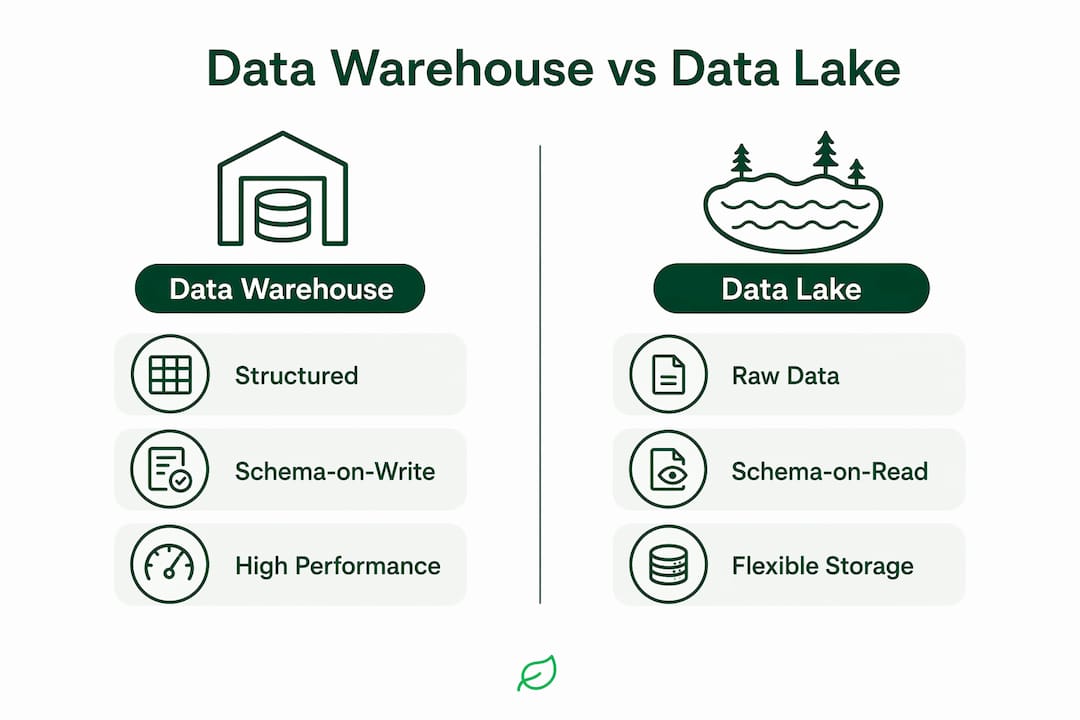
A data warehouse stores structured, processed data using schema-on-write for fast, reliable queries. A data lake stores raw, structured, and unstructured data using schema-on-read for flexible, low-cost ingestion. If you run operations in a regulated US industry and you're building AI agents or workflow automations, this distinction shapes every infrastructure decision you'll make.
Table of Contents
- How do data warehouses and data lakes actually differ?
- Schema-on-write vs schema-on-read: what it means for your data
- When should you use each architecture?
- Operational realities: cost, performance, and management overhead
- How Cannatract approaches data architecture for regulated AI workflows
- What to do next: your data infrastructure decision checklist
- Key Takeaways
- FAQ
How do data warehouses and data lakes actually differ?
The gap between these two architectures is not just technical. It affects cost, compliance posture, and how quickly your AI systems can act on data.
- Data warehouse: Structured data only, schema enforced before storage, optimized for fast SQL queries and business intelligence reporting.
- Data lake: Structured, semi-structured, and unstructured data, schema applied at query time, optimized for storage volume and flexibility.
- Data lakehouse: A hybrid that combines low-cost lake storage with warehouse-like management, supporting ACID transactions and both BI and AI/ML workloads from a single source.
| Dimension | Data Warehouse | Data Lake |
|---|---|---|
| Data type support | Structured only | Structured, semi-structured, unstructured |
| Processing model | ETL (transform before load) | ELT (transform after load) |
| Query performance | Sub-second, out of the box | Slower without tuning |
| Cost | Higher storage and compute cost | Lower storage cost at scale |
| Ease of management | Managed, lower overhead | Requires engineering effort |
| Use cases | BI, reporting, compliance dashboards | ML training, raw data archiving, IoT |
The lakehouse closes most of the gap by adding governance and performance features on top of lake storage, but it introduces its own operational demands.
Schema-on-write vs schema-on-read: what it means for your data
Schema enforcement is where the two architectures diverge most sharply in practice, and where regulated businesses feel the difference most.
Schema-on-write requires you to define your data structure before loading it. Every record conforms to a validated format the moment it enters the warehouse. The payoff is consistency: queries run fast, data quality is predictable, and auditors can trust what they see. For HIPAA-covered entities or organizations subject to financial reporting requirements, that predictability is not optional.
Schema-on-read defers structure decisions until query time. Data lands in the lake in its raw form, whether that's JSON logs, medical imaging metadata, or sensor streams. You gain speed of ingestion and storage flexibility, but you take on the burden of validation downstream.

| Feature | Schema-on-Write (Warehouse) | Schema-on-Read (Lake) |
|---|---|---|
| Data consistency | Enforced at ingestion | Enforced at query time |
| Ingestion speed | Slower (transform first) | Faster (load raw) |
| Query reliability | High | Variable without governance |
| Governance effort | Built in | Requires additional tooling |
| Best for | Regulated reporting, BI | ML pipelines, exploratory analytics |
For regulated environments, schema-on-read flexibility can be a liability without proper metadata management and governance automation layered on top. Lakes can drift into what practitioners call a "data swamp" when ingestion outpaces governance.
When should you use each architecture?
Choosing the right system comes down to your workload, your data types, and your compliance obligations. Here are the scenarios where each architecture earns its place.
-
Stable BI and regulatory reporting call for a warehouse. Finance teams running daily P&L dashboards, compliance officers generating HIPAA audit trails, and operations managers tracking KPIs all benefit from the consistency and speed a warehouse delivers.
-
Raw data ingestion at scale suits a lake. If you're collecting clickstream data, IoT sensor feeds, or unstructured clinical notes, a lake lets you store data first and process it later without designing a schema upfront.
-
Machine learning model training belongs in a lake or lakehouse. Warehouses cannot efficiently serve concurrent AI training workloads on unstructured data. Lakes provide the volume and variety ML pipelines need.
-
Converging BI and AI workloads point to a lakehouse. When your team needs governed dashboards and ML pipelines running against the same data, a lakehouse eliminates the duplication of maintaining separate systems.
-
Regulated industries with mixed data types often land on a hybrid approach: a warehouse for governed reporting and a lakehouse for AI/ML. Organizations frequently start with a lake and mature into a lakehouse as usage patterns solidify, avoiding costly data movement overhead.
-
High-concurrency analytics favor the warehouse. The lakehouse's ACID transactions and multi-engine support enable concurrent workloads, but warehouses still deliver more predictable performance at scale for pure BI.
Operational realities: cost, performance, and management overhead
The architecture you choose determines how much engineering time you spend keeping it healthy.
"Warehouses provide sub-second query performance with minimal manual tuning. Lakehouses match this only after significant optimization effort — compaction, manifest consolidation, and snapshot expiration are ongoing requirements, not one-time tasks." — LakeOps Practical Guide
Warehouses tightly couple storage and compute within a single vendor system. That integration delivers built-in metadata management, workload management, and query optimization from day one. The tradeoff is cost: you pay a premium for that convenience, and scaling storage means scaling spend.
Lakehouses decouple storage from compute, which cuts storage costs significantly. But without ongoing maintenance, performance degrades. File compaction, metadata cleanup, and snapshot expiration are not optional hygiene tasks. Skip them and your lakehouse drifts toward a data swamp, with slow queries and unpredictable costs.
Key operational considerations:
- Security: Warehouses offer centralized access controls and audit logging by default. Lakes require you to configure and enforce these separately, which matters for HIPAA and SOC 2 compliance.
- Data quality: Warehouse ETL pipelines catch errors before storage. Lake ELT pipelines can let duplicates and malformed records accumulate if validation isn't automated.
- Engineering headcount: Businesses with limited data engineering resources benefit from managed warehouses. Lakehouses demand specialized maintenance skills.
- AI data preparation: AI Excel data transformation and similar analytics workflows run more reliably against warehouse-quality data than against raw lake storage.
How Cannatract approaches data architecture for regulated AI workflows
Picking the right architecture is only half the problem. Connecting it to compliant, automated workflows is where most regulated businesses stall.
Cannatract's AI automation services are built around this exact challenge. Whether your compliance requirements point to a tightly governed warehouse or a hybrid lakehouse, the automation layer on top needs to handle structured reporting data and unstructured inputs like documents, voice transcripts, and sensor feeds simultaneously.
- Assess your data types first. If your AI agents consume structured CRM and billing data, a warehouse is the right foundation. If they process contracts, clinical notes, or multimedia, you need lake or lakehouse storage.
- Map your compliance obligations. HIPAA requires auditability and access controls. GDPR considerations in US operations add data residency and deletion requirements. Schema-on-write architectures make both easier to enforce.
- Plan for governance from day one. Flexible lakes without metadata management become compliance liabilities. Cannatract builds governance automation into every data workflow it deploys.
- Match your engineering capacity to the architecture. A managed warehouse is the right call if you don't have dedicated data engineers. A lakehouse makes sense when scalability and ML workloads justify the maintenance investment.
Pro Tip: Don't let the lakehouse's flexibility become a governance gap. Define your data access policies, retention schedules, and audit logging requirements before you ingest a single record. Retrofitting governance onto an ungoverned lake is far more expensive than building it in from the start.
If you're ready to evaluate your current data infrastructure and map it to a compliant AI automation strategy, book a free automation audit with Cannatract. You'll get a clear scope, a fixed quote, and a working system in 2–4 weeks.
What to do next: your data infrastructure decision checklist
The data warehouse vs data lake decision comes down to four variables: data types, workload patterns, compliance requirements, and engineering capacity.
- Choose a warehouse when you need fast, governed BI on structured data with minimal engineering overhead.
- Choose a lake when you need affordable storage for raw, unstructured, or high-volume data feeding ML pipelines.
- Choose a lakehouse when BI and AI workloads converge and your team can sustain the maintenance it requires.
- Audit your compliance posture before committing to any architecture. HIPAA, SOC 2, and GDPR considerations all favor schema-on-write or carefully governed lakehouses over ungoverned lakes.
- Engage expert services when the architecture decision intersects with custom AI agent development. The wrong foundation makes every automation harder to build and harder to audit.
Key Takeaways
The most effective data architecture for regulated US industries combines a governed warehouse for BI and compliance reporting with a lakehouse for AI and ML workloads.
| Point | Details |
|---|---|
| Schema enforcement matters most | Warehouses enforce schema at ingestion; lakes defer it, creating governance risk in regulated environments. |
| Lakehouses require active maintenance | Without compaction and metadata cleanup, lakehouse performance degrades and costs rise unpredictably. |
| Workload type drives the choice | BI and reporting favor warehouses; ML training and raw data ingestion favor lakes or lakehouses. |
| Compliance shapes architecture | HIPAA and SOC 2 requirements align more naturally with schema-on-write warehouse controls. |
| Hybrid approaches are common | Many regulated enterprises run a warehouse for governed reporting and a lakehouse for AI/ML pipelines. |
FAQ
What is the main difference between a data warehouse and a data lake?
A data warehouse stores structured data with schema enforced before ingestion, optimizing for fast queries and BI. A data lake stores raw, structured, and unstructured data with schema applied at query time, prioritizing storage flexibility and low cost.
When should a regulated business use a data lakehouse instead?
A lakehouse makes sense when your organization needs both governed BI reporting and AI/ML workloads running against the same data, and you have the engineering capacity to maintain it through compaction and metadata management.
How do HIPAA requirements affect the choice between a warehouse and a lake?
HIPAA's auditability and access control requirements align more naturally with warehouse architecture, where schema-on-write enforces data consistency and centralized access logging is built in. Lakes require additional governance tooling to meet the same standards.
What is schema-on-read vs schema-on-write in plain terms?
Schema-on-write means data is structured and validated before it's stored, as in a warehouse. Schema-on-read means raw data is stored first and structure is applied only when you query it, as in a lake.
Can a data lake replace a data warehouse for business intelligence?
Not reliably. Data lakes lack the governance and sub-second query consistency that BI reporting requires. A lakehouse can bridge the gap, but a pure lake without warehouse-like features is a poor substitute for governed analytics.